← Back to Products

Know what your agent can do wrong
before it runs in production.

Pre-deployment security analysis for AI agents. We audit your agent's code, tool configurations, and permission model — surfacing prompt injection paths, privilege escalation risks, and multi-agent trust chain vulnerabilities before you ship.

Three layers of risk,
audited before deployment.

AI agents introduce attack surfaces that traditional security tools don't understand. We analyze the layers specific to agentic systems — before they're live.

Tool & API Security

Can your agent be manipulated into executing unauthorized tool calls via prompt injection? We trace every tool call path for SSRF (Server-Side Request Forgery), RCE (Remote Code Execution), and API abuse vectors — including indirect injection through retrieved context and chained tool outputs.

Prompt injection → tool call · SSRF · RCE · API abuse

Permission & Privilege Model

We audit every tool's permission scope against the least-privilege principle. Over-permissioned tools, missing tool-level IAM (Identity and Access Management) boundaries, and dynamic authorization gaps are mapped before they become blast radius in production.

Least privilege audit · tool-level IAM · privilege escalation paths

Multi-Agent & Memory Risk

In multi-agent systems, one compromised agent can pollute the trust chain of the entire system. We also assess long-term context memory for poisoning vectors and malicious knowledge injection paths that shift agent behavior over time.

Trust chain analysis · context poisoning · knowledge injection

Agentic attack surface
mapped before it's exploited.

Agent systems introduce a new class of vulnerabilities that don't appear in traditional code review. Our analysis covers all of them.

Agent attack surface

What attackers target in agentic AI systems

  • Tool call manipulation — prompt injection forces unauthorized API, shell, or DB calls
  • Privilege escalation via tool chaining — combining limited-scope tools to reach sensitive resources
  • SSRF via external tool inputs — agent-initiated requests reaching internal infrastructure
  • Long-term context poisoning — gradual corruption of agent memory to shift behavior
  • Multi-agent trust chain pollution — one compromised agent propagating malicious instructions
  • Auto-execution of sensitive operations — delete, transfer, modify without human-in-the-loop controls

What our analysis delivers

Pre-deployment findings with actionable fix guidance

  • CVE-class findings mapped to your specific agent configuration
  • Reproduction steps for each identified attack path
  • Permission model gaps and recommended least-privilege scoping
  • Tool-level IAM recommendations per agent role
  • Multi-agent trust boundary assessment with isolation recommendations
  • Memory and context handling risk assessment with remediation guidance

What the analysis
actually produces.

Code Audit Agent —
what breaks before it ships.

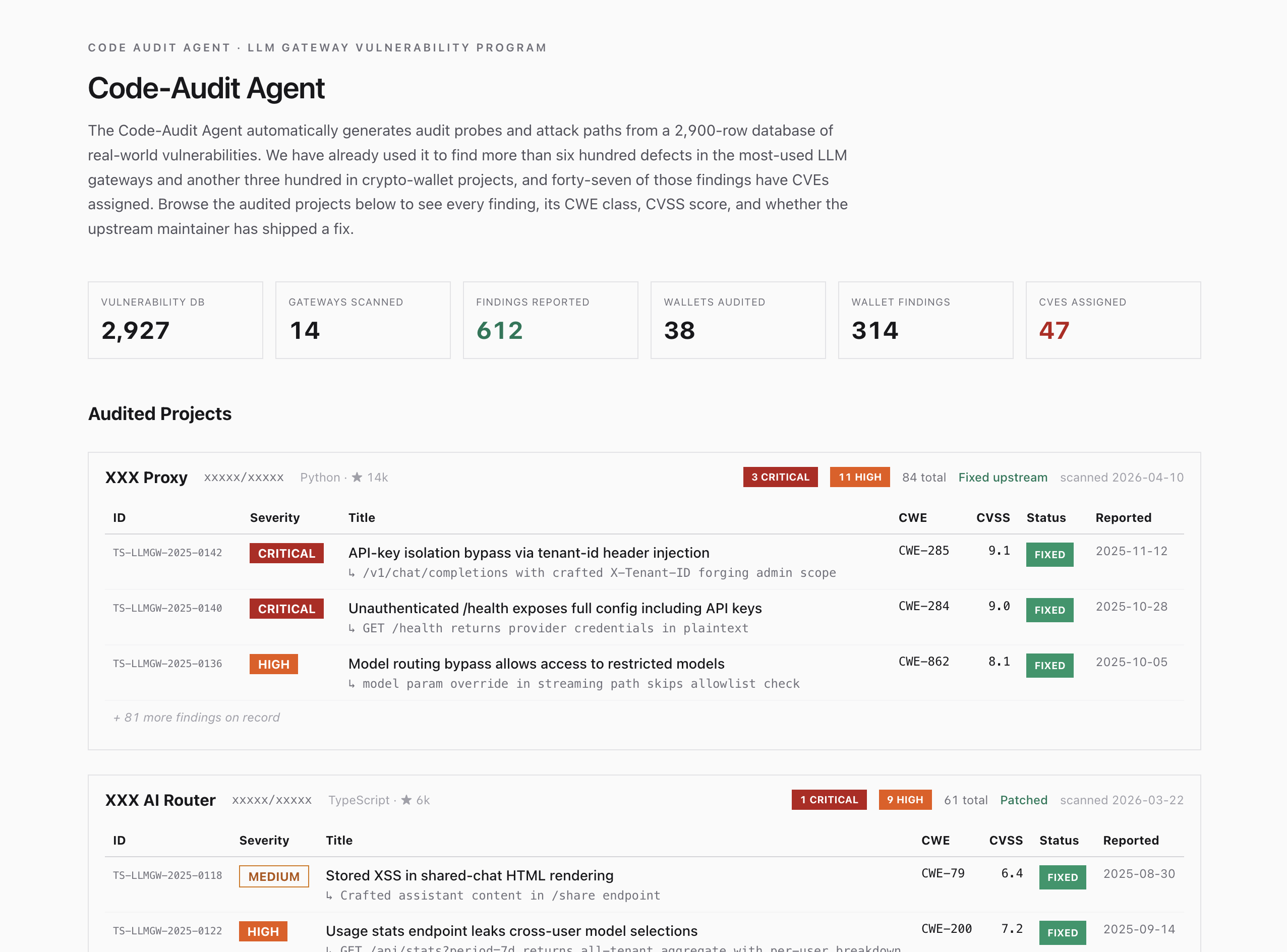
A fine-tuned audit LLM reviews your agent codebase and surfaces implementation-level flaws: unsafe deserialization, authorization logic errors, secret leakage, and privilege escalation paths. Every finding includes CWE class, CVSS score, reproduction steps, and fix guidance.

  • CRITICAL / HIGH / MEDIUM severity ranking

  • Signed findings entry in the shared evidence chain
tracestone.io
Code Audit Agent — CVE-class findings report

MCP Server Scan —
OWASP-aligned checks.

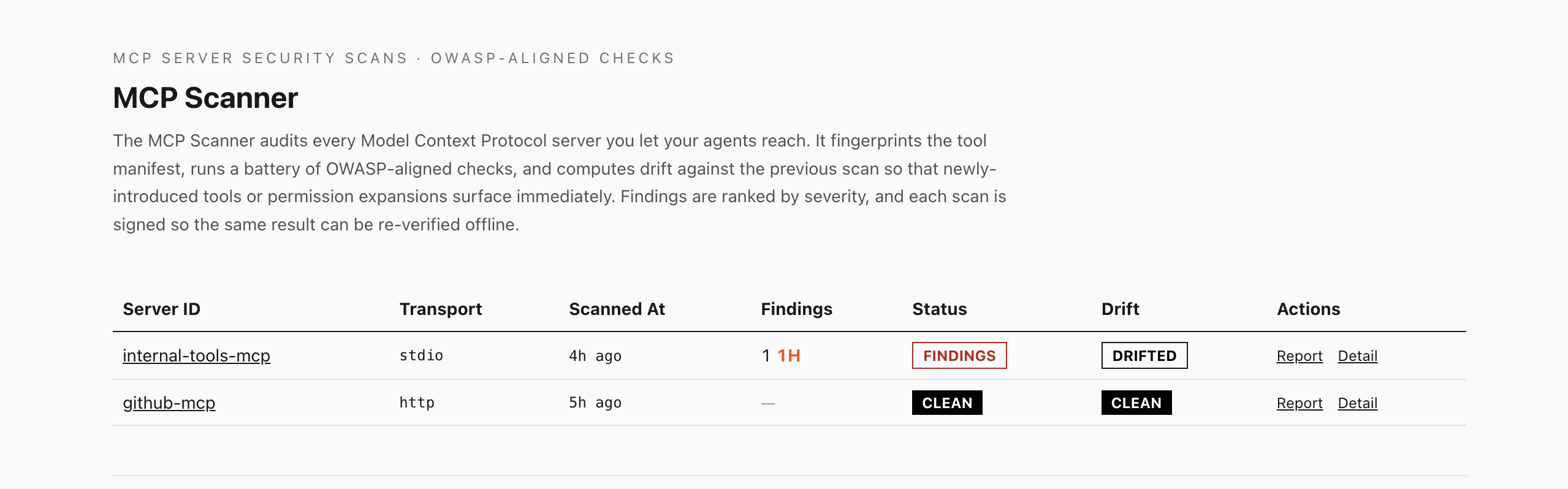
Every MCP server your agent can reach is fingerprinted against OWASP checks. Drift from the previous scan surfaces immediately — new tools or expanded permissions never go unnoticed.
tracestone.io
MCP Server Security Scan report

Red-Team Evaluation
against OWASP LLM Top 10.

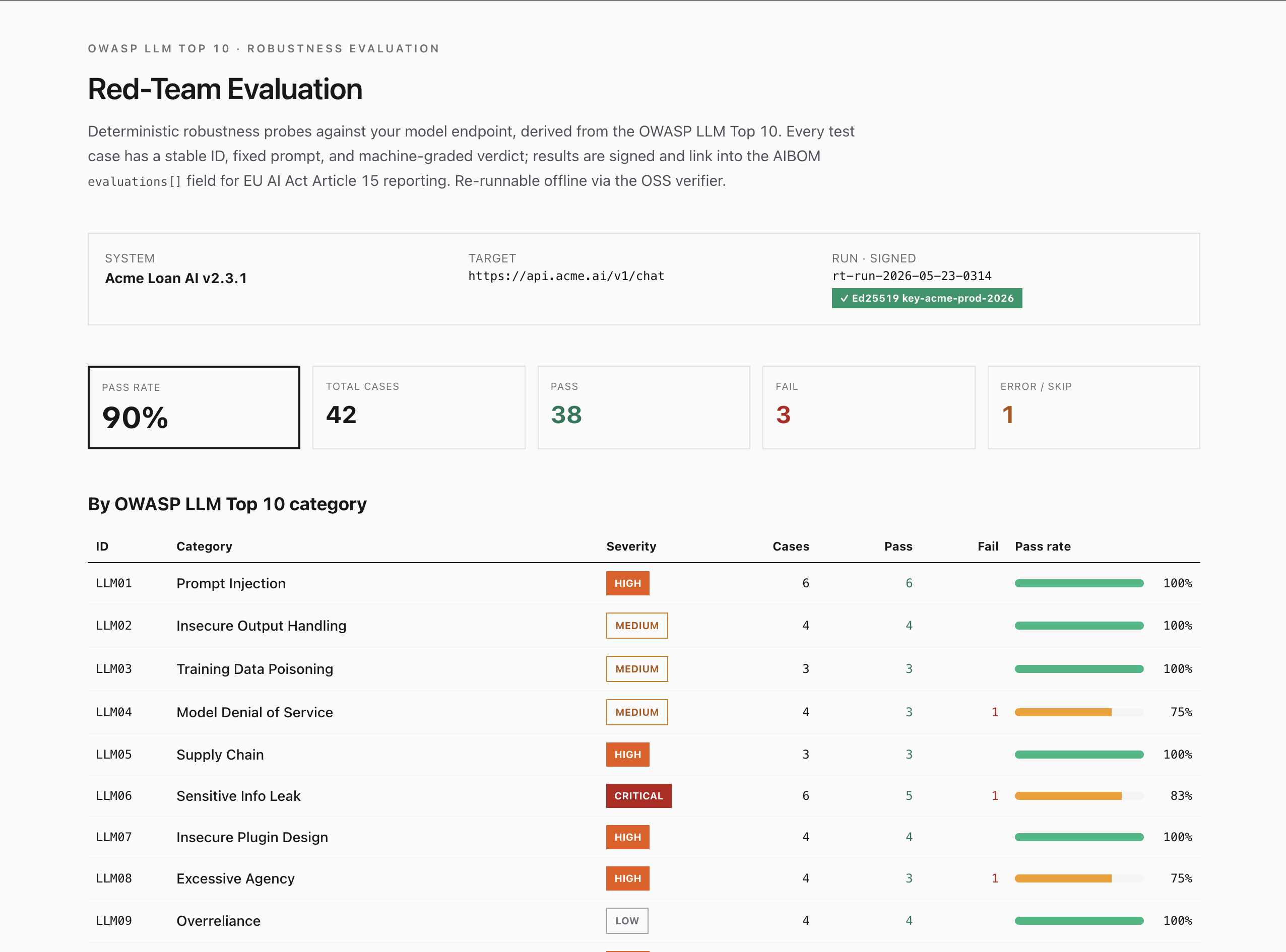
Deterministic probes against your model endpoint covering all ten OWASP LLM categories — Prompt Injection, Sensitive Info Leak, Supply Chain, Excessive Agency, and more. Each test case has a stable ID and fixed prompt; results are machine-graded, signed, and link into the evidence chain for EU AI Act Article 15 reporting.

  • 42

    Test cases across 10 OWASP LLM categories

  • Ed25519-signed run certificate per evaluation

  • Re-runnable offline via the OSS verifier
tracestone.io
Red-Team Evaluation — OWASP LLM Top 10 results

After deployment: Evidence-AIDR takes over.

Agent Security covers everything before your agent goes live. Once deployed, Evidence-AIDR monitors runtime behavior continuously — detecting prompt injection attempts, policy bypass, and anomalous tool usage in real traffic, while maintaining a tamper-evident audit trail any regulator can independently verify.

Together, they cover the full agent lifecycle: security-tested before deployment, monitored and auditable after.

See Evidence-AIDR →

Deploying an agent soon?

Share your agent code and tool configurations with us. We'll run the pre-deployment analysis and deliver a findings report before you go live.

Request sample report