For auditors
Check agent actions. Without seeing the data.
Your client hands you proof that their rules held, not raw logs full of names and amounts. You check it on your own machine and get a clear answer.
- Offline verifier
- Zero-knowledge proofs
- Independent checkpoints
What you receive
You get proof. Not raw logs.
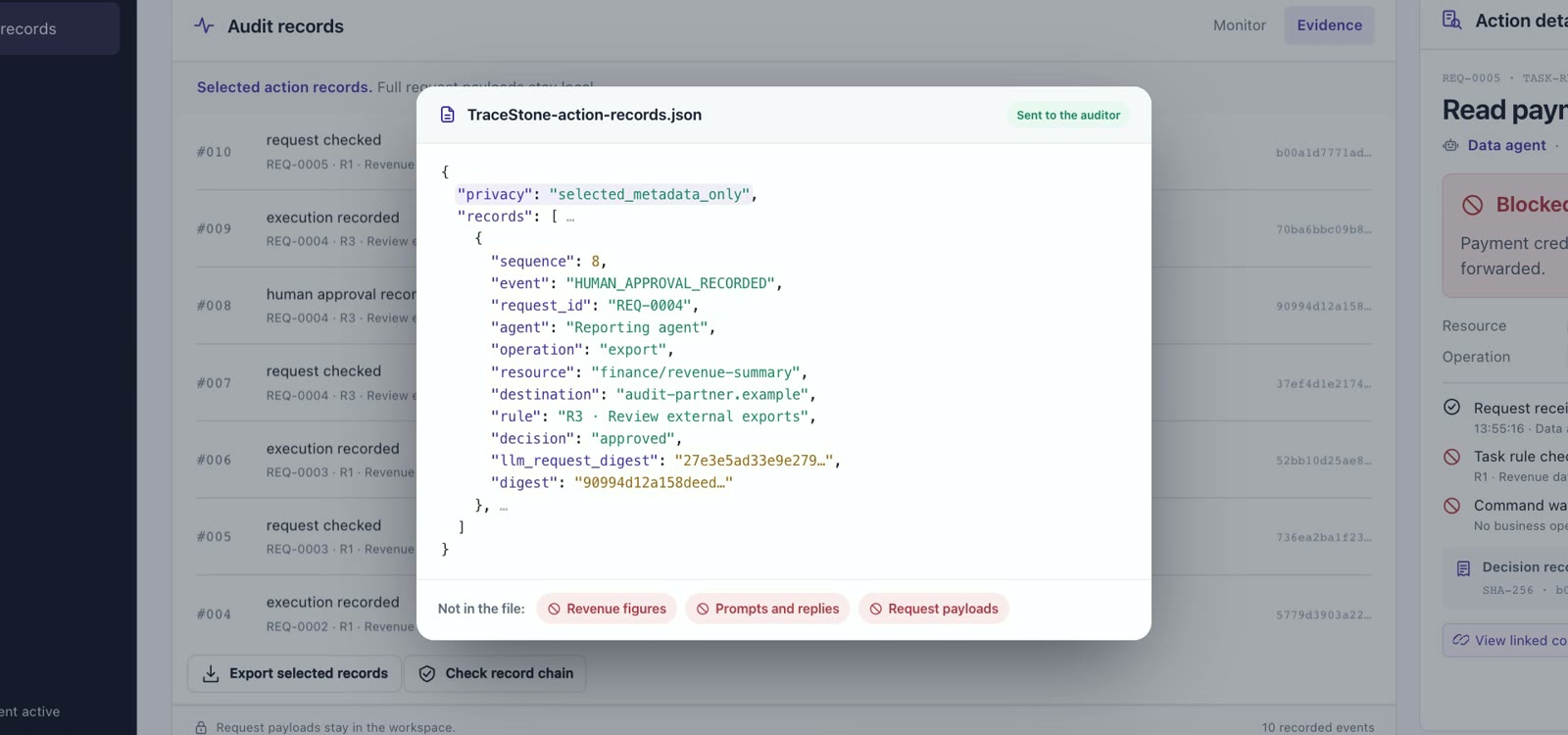
Your client shares only the records the audit asks for. Names, amounts and prompts stay inside their company.
- Only what the audit needs Selective disclosure: you get the records in scope, nothing more.
- Rules proven, values hidden A zero-knowledge proof shows a payment stayed below its limit, without the amount.
- Approvals proven, names hidden You see that an action had a valid approval, not who gave it.
- Sealed checks Complex checks run in a trusted execution environment, with remote attestation.
 TraceStone
Offline verifier
Check it yourself. Get a clear answer.
Run the offline verifier on your own machine. Every claim gets a clear answer.
- Runs on your machine No access to your client's systems, no need to take their word.
- One answer per claim Verified, failed or inconclusive, so you know where you stand.
- No silent passes Missing evidence never counts as a pass.
Tamper-proof records
Records no one can rewrite. Not even TraceStone.
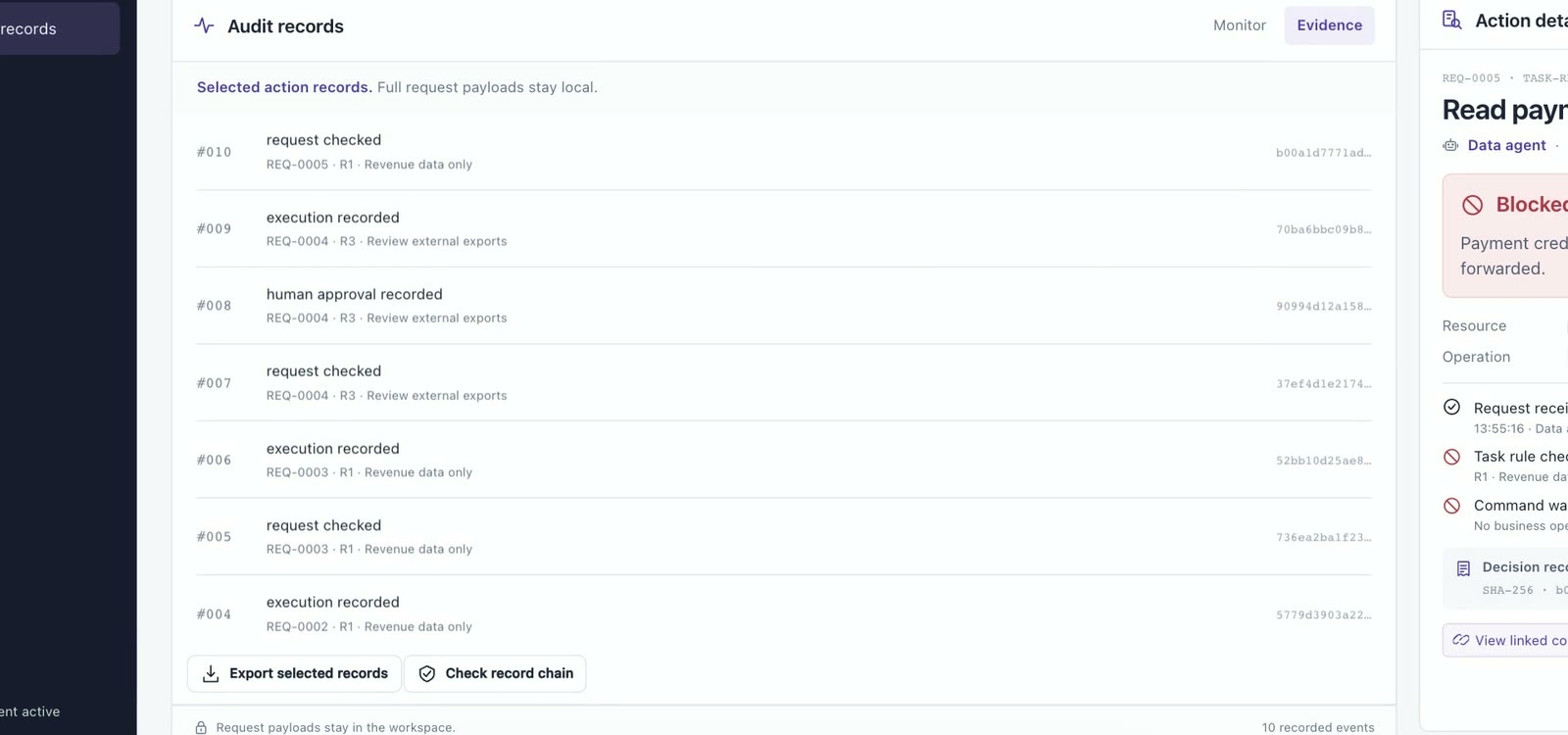
Each record is signed and linked to the one before. A removed, added or changed record is detected.
- Signed and linked Each record seals the one before it, so a gap shows at once.
- Check one record A Merkle tree lets you check one record without the whole log.
- Independent checkpoints Signed checkpoints go to an independent service, so even TraceStone cannot rewrite history.
Do I need access to my client's systems?
No. Your client sends you a file with the selected records and their proofs. The offline verifier runs on your own machine, with no access to your client's systems, and marks each claim as verified, failed or inconclusive.
How can I check a rule without seeing the values?
Zero-knowledge proofs show that a rule held without revealing the value: for example, that a payment stayed below its limit without the amount, or that an action had a valid approval without who approved it. Complex checks can run in a trusted execution environment (TEE), with remote attestation.
How do I know no record is missing?
Each record is signed and linked to the one before it, so a removed, added or changed record is detected. A Merkle tree lets you check one record without the whole log, and regular signed checkpoints go to an independent transparency service. If evidence is missing, the claim is inconclusive: it never counts as a pass.