For banks and financial institutions
Put AI agents to work. Show the oversight regulators expect.
Every agent action is checked against your rules before it runs. Payments over your limit wait for a person, and your auditor gets proof without your customers' data.
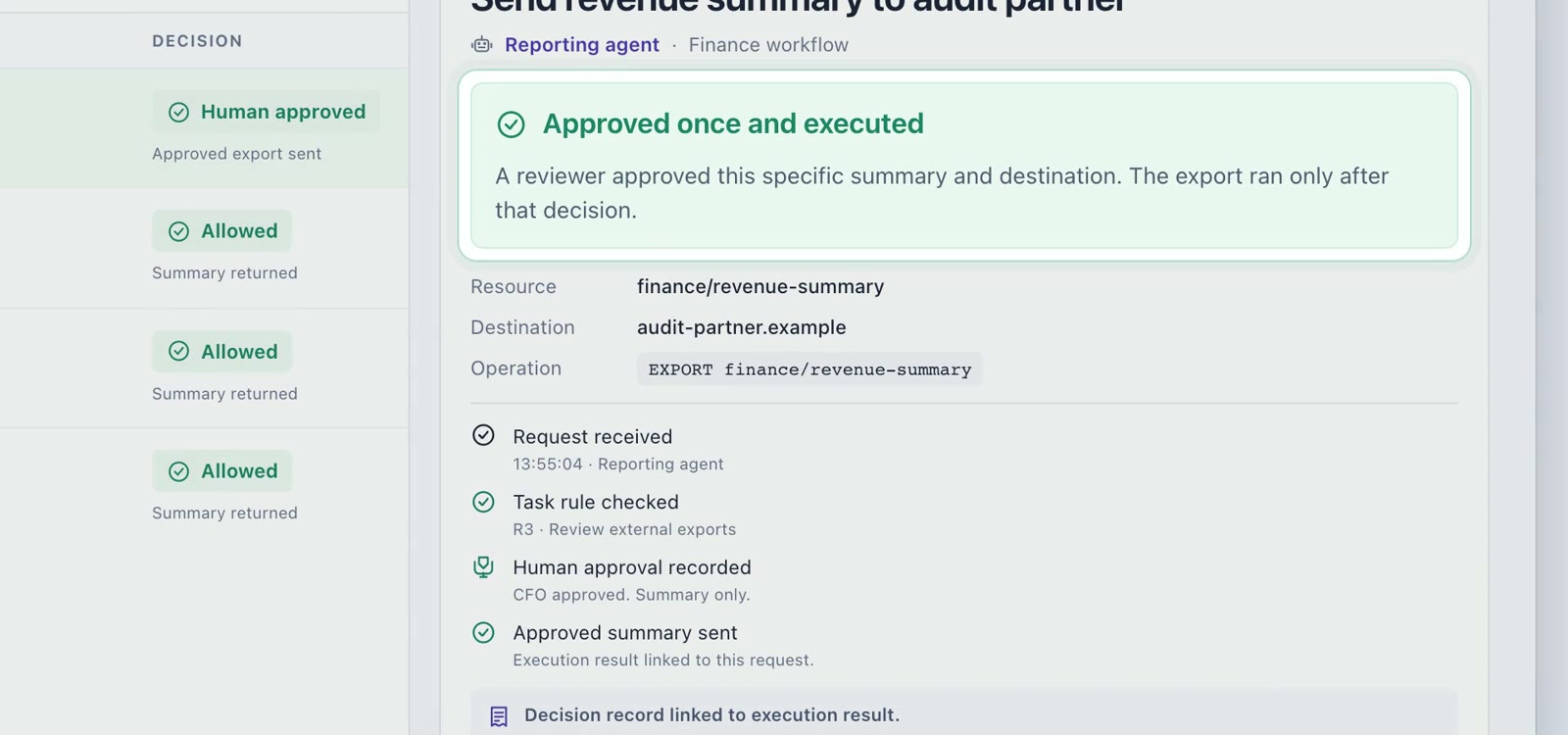
- Ran only after your CFO approved
- Every step kept as a signed record
Approval limits
Big payments wait. A person decides.
You set the limit. Payments above it stop and wait for your approver, and run only after that decision.
- Your limits, your call MAS sets no dollar figure. You set the limits that fit your firm.
- One approval, one action Your approver signs off on that payment only. Then it runs.
- Out of scope means blocked Actions outside the approved task are never forwarded.
- Every decision signed Who approved what, and when, is kept as a signed record.
Example: your rule says payments over S$10,000 wait for a person. A payment of S$3,100 to R. Lim is under your limit and runs. A payment of S$12,400 to J. Tan waits; the CFO approves it, and only then does it run. A request to read payment credentials is outside the approved task and is blocked. Each decision becomes a signed record, #021 to #023.
Records of AI use
Every agent action. On the record.
Regulators expect you to show what your AI did. TraceStone keeps a signed record of every request, decision and approval.
- What each agent did The request, the rule applied, the decision and the result, with the time.
- No quiet edits Each record is signed and linked to the one before, so changes show.
- Checkpoints outside your walls Signed checkpoints go to an independent service, so even we cannot rewrite your history.
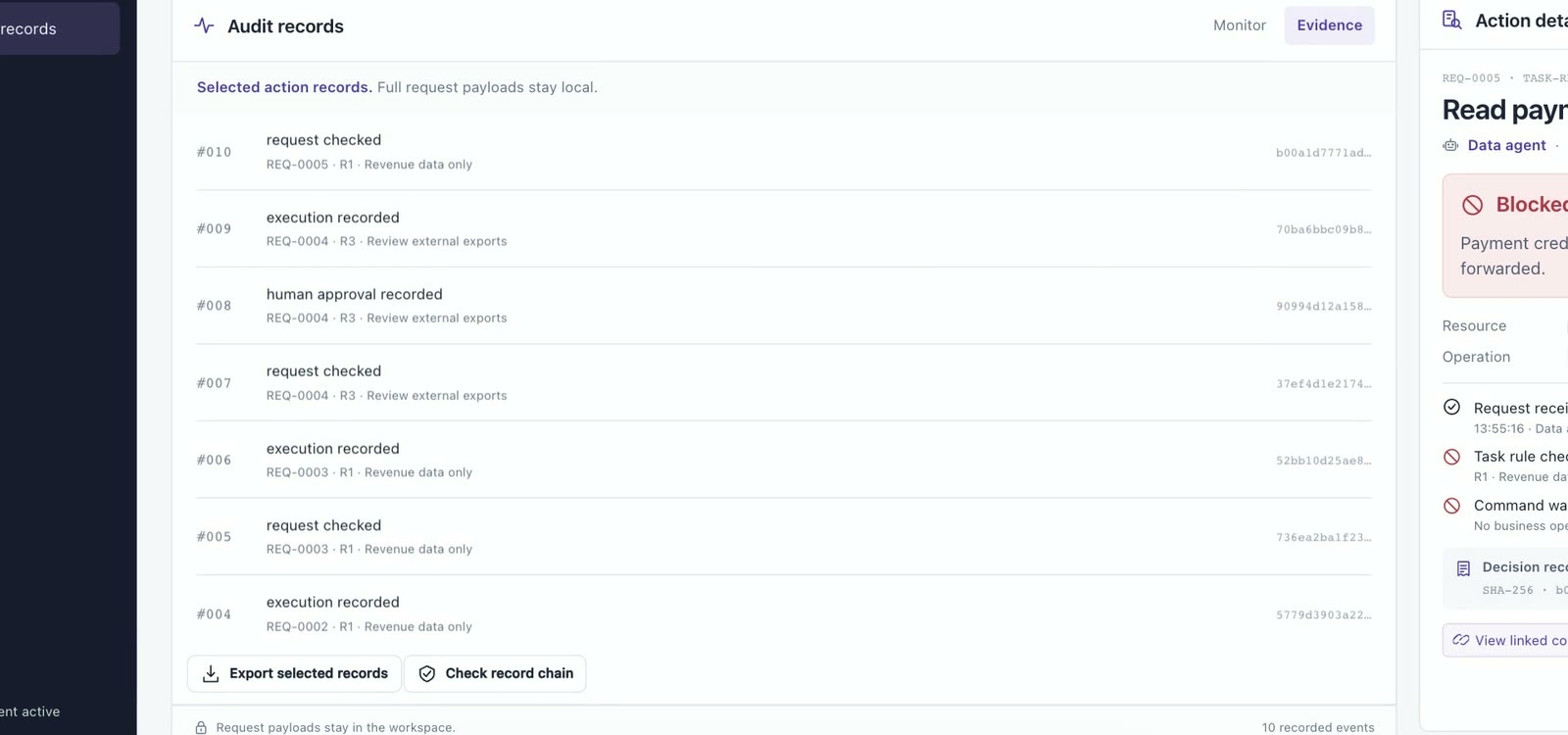
- Each record linked to the one before
- Approvals recorded beside the action
Private audit
Give your auditor proof. Not your customers' data.
Your auditor gets the records the audit needs and proof that your rules held. Revenue figures, prompts and request payloads stay with you.
- Only what the audit needs You export selected records, never the full request payloads.
- Proof without the values Zero-knowledge proofs show a payment stayed below its limit, without the amount.
- Checked offline Your auditor's verifier needs no access to your systems.
- Clear verdicts Verified, failed or inconclusive. Missing evidence never counts as a pass.
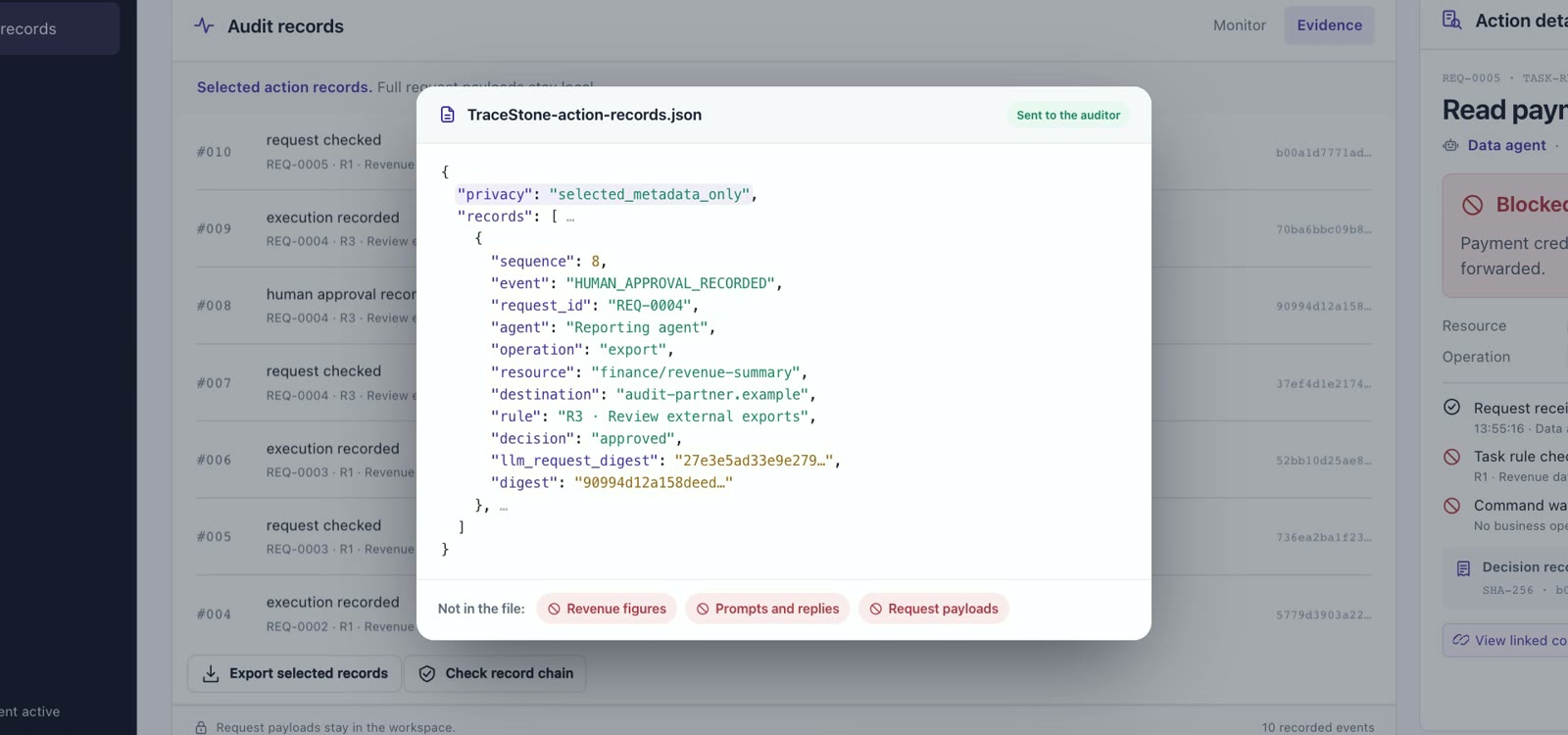
- Only selected metadata goes out
- Customer data stays with you
Deadlines
The MAS dates are set. Be ready before them.
MAS issued its Guidelines on AI Risk Management on 7 Oct 2026. TraceStone helps you show the human oversight and records they expect.
- Show human oversight Risky actions wait for a person, and each approval is recorded.
- Keep records of AI use Signed records show what each agent did, and when.
- Check before action As the MAS SAFR paper recommends, each action is checked before it runs.
- Published MAS Guidelines on AI Risk Management Issued for financial institutions in Singapore
- Today · Nov 2026
- in 11 months AI inventory expected A list of the AI you use
- in 13 months EU AI Act high-risk rules For example credit scoring, if you serve the EU TraceStone helps with Records Approvals
- in 23 months Human oversight expected Life-cycle controls under the MAS Guidelines TraceStone helps with Approvals Signed records
Is TraceStone enough to meet the MAS Guidelines?
No tool can do that on its own. TraceStone helps you show two things the Guidelines expect: human oversight of risky actions, and records of what your AI did. Your AI inventory and your wider risk framework stay with your own teams.
Who sets the approval limits?
You do. MAS sets no dollar figure, so each firm sets its own limits; for example, payments over S$10,000 wait for a person. Task-aware rules come from each user request, the available tools and the workflow, and are checked against your policy and formally verified before use.
Does customer data leave our environment?
No. TraceStone runs inside your environment: your own servers, your private cloud or a hybrid setup. Your auditor receives selected records and proofs, not customer names, amounts or prompts, and checks them offline.